
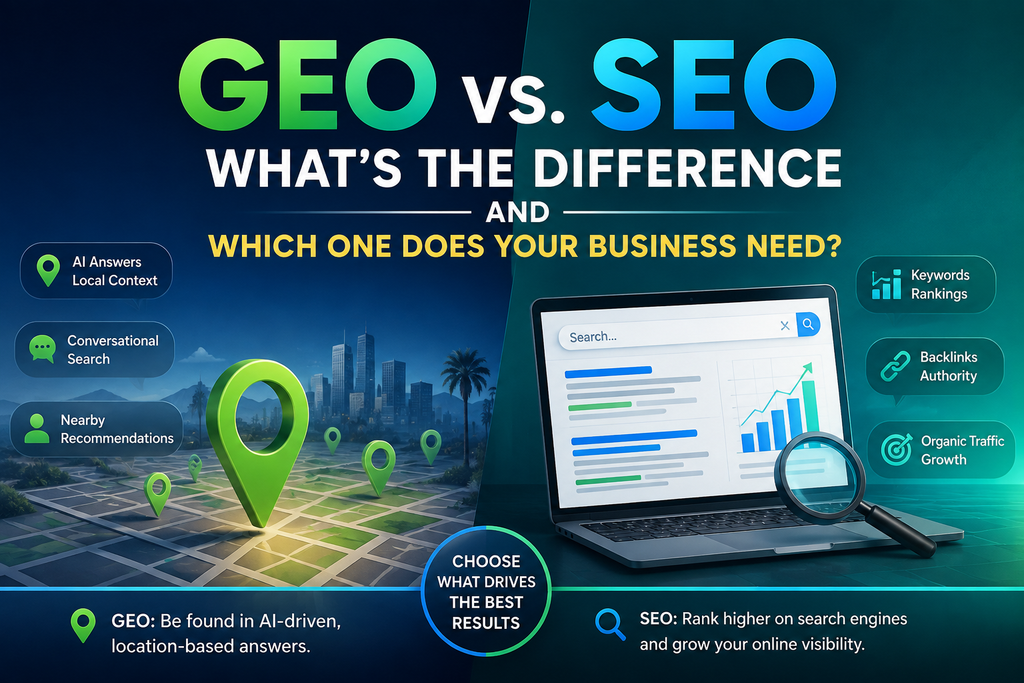
GEO vs. SEO: Dual Optimization for Your Website
The Google we knew has changed. What was once keyword searching has now turned into looking up complete statements. Websites used tools to boost their presence in search engines. Before the introduction of AI, it was SEO. Now, websites also need to manage their visibility in AI Mode and Overviews. This is where GEO pops in. Let us look at the definitions:
SEO – Search Engine Optimization
The tool that helps your content rank in Google’s search results. It works on:
- Keyword research
- Internal linking
- Schema markup
- Building backlinks
GEO – Generative Engine Optimization
The tool that makes your website appear and get cited in AI-generated answers and overviews. It works on:
- Factual information
- Concise language
- Structured content
- Trusted sources
SEO and GEO are two sides of the same coin. They share the same foundation: helping users find the best solution.
How are GEO and SEO similar?
We all know about SEO. After conducting in-depth keyword research, you can tactfully infuse those keywords into the content so that when users search those keywords, the website appears first. But that was the old way. Keywords are still very important. But today, how you use them matters more.
With AI, search results have become more user-friendly. Google now shows AI summaries first, so users can quickly see their solutions. It cites websites next to the summary if users want to learn more. That is how GEO works. But let’s put that aside for a second. Since they both are designed to increase your website’s visibility, let us look at what makes GEO and SEO similar:
- Both aim to maximize your brand’s visibility
- They want to showcase your expertise to the right target audience
- Both tools favor content showing EEAT (Experience, Expertise, Authoritativeness, and Trustworthiness) principles
- They prefer fast load times, clean site structure, and mobile responsiveness
AI SEO is on the rise. So, let’s talk about the differences and how to get the best results with Generative Engine Optimization and Search Engine Optimization.
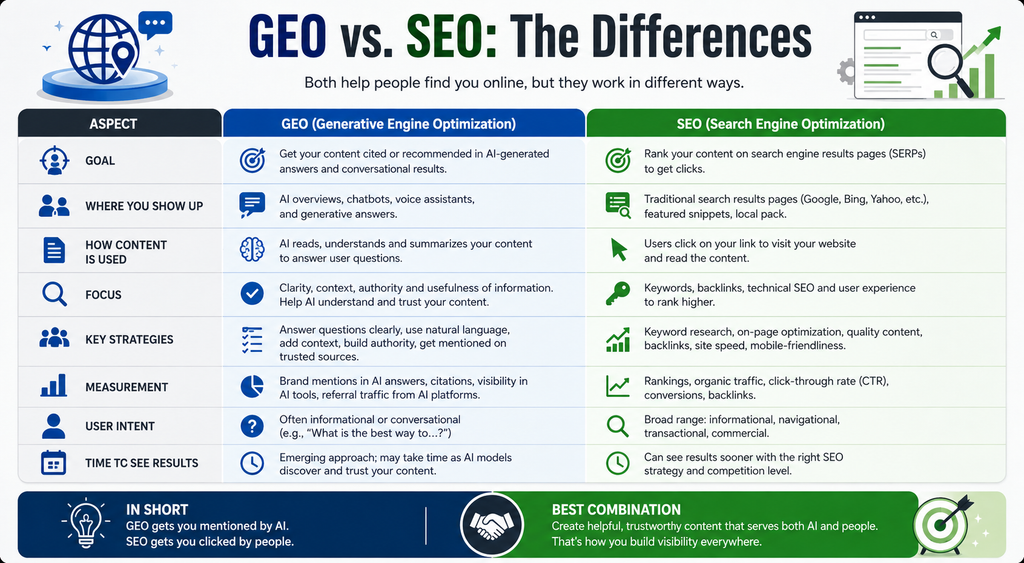
GEO vs. SEO: The Differences
By now, we have established that you need both SEO and GEO for the best brand visibility. But even though their crux is the same, let us talk about what makes them unique.
| Category | GEO | SEO |
| Search Results | AI-driven platforms like Google AI Overviews, Google AI Mode, Google Gemini, ChatGPT, Perplexity, and Microsoft Copilot | Standard search engines like Google, Bing, and Yahoo |
| Query Format | Natural language prompts and conversational phrasing | Exact keywords and metadata |
| Content Delivery | Offers zero-click AI summaries | Direct clicks to your website |
| Growth Metrics | Tracking brand mentions, citations, and visibility inside AI models | Tracking organic traffic and rankings |
SEO is a traditional tool that focuses on ranking blue links on the Search Engine Results Page. With the right keywords, metadata, and backlinks, the website earns user clicks and organic traffic. With GEO optimization, websites focus on uploading structured data and factual content so that AI tools cite your website inside an AI-generated answer.
Generative Search Optimization is all about giving your target audience exactly what they need. From conversational clarity to direct facts, GEO rewards technical precision, structure, and discoverability.
Bonus: Points to your business if your website gets third-party mentions. It makes your business more trustworthy and a better associate in your industry, establishing you as an expert.
Does your business need GEO or SEO?
When it comes to getting the most out of your website, there can be no GEO vs. SEO. You’d have to focus on them both in parallel. GEO builds on top of SEO. The better your content is structured and verified by external sources, the more reliable your website becomes for AI tools to cite your business in their answers and summaries.
So, the question you need to ask is about proportion. The first question is what tool your audience uses to search. If your audience is entering prompts in ChatGPT and Perplexity, you’d have to focus on your website’s GEO. SEO here plays a role as the foundational data layer. It ensures AI can crawl your website, retrieve information, and summarize it for the audience.
Since both SEO and GEO are required to improve your website’s visibility, the next question you need to answer is what kind of information is your audience looking for? If your audience is looking for your business name directly, then traditional SEO ensures they find your website immediately. GEO fills the gap and ensures AI tools recommend your brand as the answer.
That is why, to get the best visibility for your business, you need to work on both strategies to reach today’s audience.
Boost Visibility with GEO and SEO Tools
Modern searches have moved on from keywords to conversations. That is why SEO for AI search is all about answering questions and becoming a trusted, citable source for search engines and AI-driven platforms. With professional help, you can smoothly transition from traditional to conversational SEO.
From structuring your content to building authority in your industry, understanding both SEO and GEO can help you get cited, noticed by your target audience, and grow your business.
Frequently Asked Questions
Is GEO replacing SEO?
No, GEO is not replacing SEO. GEO builds on SEO. Both rely on the same web structure to improve a website’s visibility.
What are the key differences between SEO and GEO?
SEO targets traditional search engines like Google or Bing, using keywords to rank websites and drive clicks. GEO targets AI chatbots and answer engines like ChatGPT or Perplexity, using structured data and facts to secure brand citations and mentions inside AI-generated answers or summaries.
How does content optimization change for GEO?
GEO requires optimizing content for context and extractibility. AI systems prefer clear, concise answers that state facts instead of filler text around keywords. For the best GEO results, include structured questions and answers, data tables, step-by-step guides, and authoritative quotes.
How can my business combine GEO and SEO?
The most effective approach is to treat GEO and SEO as a unified pipeline. Use traditional SEO to keep pages indexable and fast-loading. At the same time, apply GEO principles by adding factual summaries and expert quotes, using schema markup, and getting high-authority external brand mentions.
Also Read: Google AI Overviews and Their Impact on Organic Traffic