
Constant alteration in artificial intelligence and automated bidding are opening up new scopes in Google Ads evolution. Privacy considerations and altering search experiences are reshaping digital advertising. Clicks and impressions no longer define modern advertising. Businesses need to understand how campaigns work and how efficient they are at generating leads.
Some significant changes in Google Ads 2026 include automation, audience signals, and AI-assisted campaign management. Businesses also need to focus on conversion measurement to reach potential buyers. Businesses are reaching potential consumers more effectively. However, they need stronger data practices and a performance monitoring system for intent.
In this blog, we’ll explore the key PPC trends for 2026. Businesses can make informed decisions about campaign structure, optimization, and budgets without relying solely on automation.
AI Is Playing a Bigger Role in Campaign Management
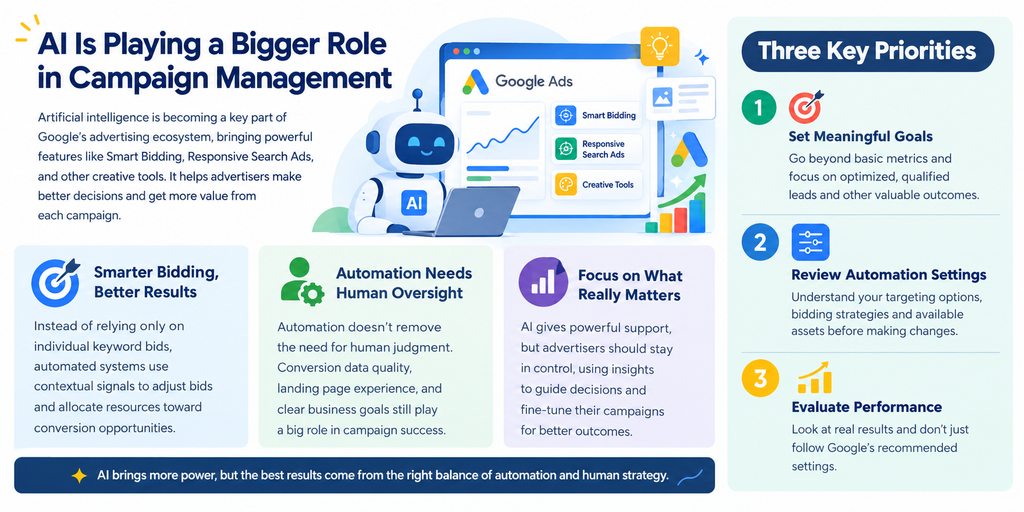
Artificial intelligence is becoming increasingly important across Google’s advertising ecosystem. This shift has introduced different features like Smart Bidding, Responsive Search Ads, and other creative tools. It helps advertisers to make informed decision and make effective use of each campaign.
Instead of relying solely on individual keyword bids, automated systems use contextual signals to adjust bids and allocate resources toward conversion opportunities.
Automation does not reduce the requirement for human oversight. Conversion data quality, landing page experience, and clear business objectives still matter for campaign results.
Advertisers focus on three priorities:
- Set meaningful goals with optimized, qualified leads and other valuable outcomes.
- Review automation settings to understand targeting options, bidding strategies, and assets.
- Businesses should evaluate performance to gauge the results, not simply rely on Google’s recommended settings.
Performance Max and Search Campaigns Require Clearer Roles
Performance Max depends on inventory across channels in Google Advertising. The channels are YouTube, Discover, Search, Maps, and Gmail. Advertisers can reach consumers at multiple stages of their buying journey.
Meanwhile, search campaigns are still useful when businesses need more direct control over specific keyword themes and search intent.
It is not about choosing one campaign over another. The best Google Ads strategy is to plan and assign campaigns with clear purpose so you can measure their contributions.
| Campaign type | Main purpose | Key consideration |
| Search | Capturing active search demand | Keyword intent and query relevance |
| Performance Max | Reach consumers across Google’s inventory | Conversio signals, assets, and reporting |
| Demand Gen | Creating demand through visual and video placements | Creating quality and audience relevance |
| Slopping | Promoting products for online shoppers | Product feed quality and pricing |
| YouTube campaigns | Developing awareness or drive action through video | Audience fit and creative effectiveness |
First-Party Data and Conversion Quality Matter More
Privacy has changed, and third-party tracking limitations have increased the importance of trusted first-party information. To make this efficient, businesses need to collect required information with consent-based procedures.
If you need to generate campaigns, you’ll need to distinguish between a form submission and an authentic lead. For an ecommerce business, that means tracking completed purchases and accurate order values.
A practical approach needs to include:
- Actions for auditing conversions and removing misleading goals.
- Tracking verification across calls, purchases, and relevant CRM systems.
- Importing qualified lead or closed-sale outcomes where appropriate
- Reviewing attribution settings and the specific conversion time.
Search Behavior Is Becoming More Complex
Consumers are gradually discovering information with AI-assisted search experiences, videos, and multiple online touchpoints. These changes are shifting advertisers’ perceptions of search intent and the consumer journey.
Some useful actions are:
- Reviewing search terms and identifying irrelevant or low-volume queries.
- By intent, some keyword groups are research, purchase, and comparison.
- Ad copy alignment with particular questions of users.
- Confirming that your landing pages can answer the query clearly
- To reduce irrelevant traffic, use negative keywords where required
Creative Quality Is a Greater Competitive Advantage
Advertisers need to test various value propositions, creative formats, and calls to action. This helps them review asset performance and ensure the automated combination stays intact and consistent with the landing page.
Here is a useful framework:
| Element | What to test | What to measure |
| Headlines | Advantages versus problem-focused messaging | CTR and conversion rate |
| Descriptions | Particular details versus common claims | Conversions and engagement |
| Calls to action | Various next-step instructions | Completed actions |
| Landing pages | Messaging alignment and page structure | Conversion rate and lead quality |
| Images and videos | Various creative approaches | Required engagement and conversions |
PPC Measurement is Moving Beyond Clicks
Impressions and clicks still have their place as diagnostic metrics. However, they do not necessarily indicate profitability. In 2026, you will need a more useful approach to connect advertising performance with downstream business outcomes.
For example, a campaign that generates 100 leads will appear stronger than one that generates 60 leads. However, if the first campaign generates mostly unqualified inquiries and the other focuses on consumers, the second campaign is more valuable.
Businesses can find it challenging to manage campaigns. Hence, they need to invest in an efficient PPC agency in USA to handle audits and track implementations. Expert agencies can also help with creative testing and reporting.
Frequently Asked Questions
What are the biggest Google Ads trends in 2026?
We’re seeing way more automation driven by AI, everybody jumping on Performance Max. Businesses are tracking conversions through creative tools and fetching desired business outcomes.
Is Google Ads still effective for small businesses in 2026?
Absolutely. Google Ads still helps small businesses connect with people actively searching for what they offer. Results depend on how you spend your budget, search intent, competition, conversion tracking, and whether your landing page pulls its weight.
How often should Google Ads campaigns be optimized?
Keep a close eye on your spend and the most important metrics. Check your search terms and conversion quality regularly, but save bigger changes for when you have enough data to back them up. Tinkering too often can muddy the waters and make it hard to see what’s really working.
Should businesses hire a PPC agency in 2026?
Hiring an agency’s a smart move if you need expert help with strategy, conversion tracking, automation, or diving into performance analysis. But before you sign on, take a hard look at how they report results, their track record, how they measure success, and whether they’re transparent with their process.
Also Read: GEO vs. SEO: What’s the Difference and Which One Does Your Business Need?