
Consequently, Shopify vs WooCommerce SEO stands as the most critical foundational choices for an e-commerce entrepreneur.
Shopify gives users the freedom to offer an automated working atmosphere. WooCommerce is a platform with an open-source framework built for total customization. People set up online stores to make sure that their visibility is achieved in every individual’s search list. This is one of the best and fastest ways to make money flow in a natural way.
When you are planning to choose between WooCommerce vs Shopify for SEO it means you are having good plans in your mind about your business. It includes looking past all the basic features that include the understanding of every platform. This handles the performance of the page set with the basic marketing features. This is meant to understand how each platform handles page performance, delivery of contents and site architecture.
Know About the Technical Foundations Architecture of the Site
The structure of the structural digital store highly determines the index of catalog. It shows how efficiently the search engine crawlers can index your catalog. This is where the core architectural differences between these platforms become most apparent.
- URL Architecture: WooCommerce has complete control over these things-permalinks, categories, and tags. It enables the developers to build a highly tailored URL layout. This structure is unchangeable and restricts huge advanced strategies of the site architecture.
- Canonical Management: Shopify frequently generates multiple URLs for a single item when it is assigned to multiple collections. WooCommerce manages product variations and taxonomies in a cleaner, native format. The rate of indexation risks for SEO in online stores is minimized.
- Sitemaps and Server Controls: Shopify in an automation handles all your XML sitemap and robots.txt files whereas WooCommerce requires an initial plugin setups for these elements. Still, it grants unrestricted access to server configuration files, rewrite all rules, and deep indexing directives.
Everything about Web Vitals, and Speed of Site Performance
- Hosted Infrastructure: Shopify operates as a hosted Software-as-a-Service (SaaS) network. Stores leverage the global, built-in Content Delivery Network (CDN) and optimize the edge computing.
- Hosting Environment: WooCommerce is self-hosted. Deploying the platform on low-tier shared hosting will disturb the performance and lower rankings. WooCommerce performance can match or exceed the alternatives of the hosted targets.
- Extension Efficiency: A clean WooCommerce setup is lightweight. This accumulates the unoptimized third-party plugins. Shopify manages its application ecosystem with strict quality standards turning it harder for non-technical users.
What Is Content Marketing and On-Page Optimization Tools
Sustainable search visibility is rarely built solely on all kinds of product listings. High-ranking brands regularly rely on editorial content. This is the reason why the structured data can capture the search intent of the top-of-funnel.
- Systems of Blogging and Content: Built on a platform of WordPress, WooCommerce follows the world’s most robust content management system. It gives it a significant structural advantage for content-led ecommerce SEO. Building complex topic clusters, and managing the deep internal linking, and hosting resource hubs alongside product pages is seamless. Shopify features a native blogging tool.
- On-Page Optimization Software: Both platforms offer excellent toolsets to manage meta descriptions, title tags, and readability. Shopify uses dedicated apps in their targeted App Store to handle Shopify SEO tasks. WooCommerce integrates with WordPress optimization. These optimization suites the Rank Math and Yoast SEO. They help in managing the comprehensive strategies of WooCommerce SEO.
- Structured Data and Rich Snippets: Structured data interprets the information of the product to search engines. WooCommerce allows granular, code-level schema customization at the very field level.
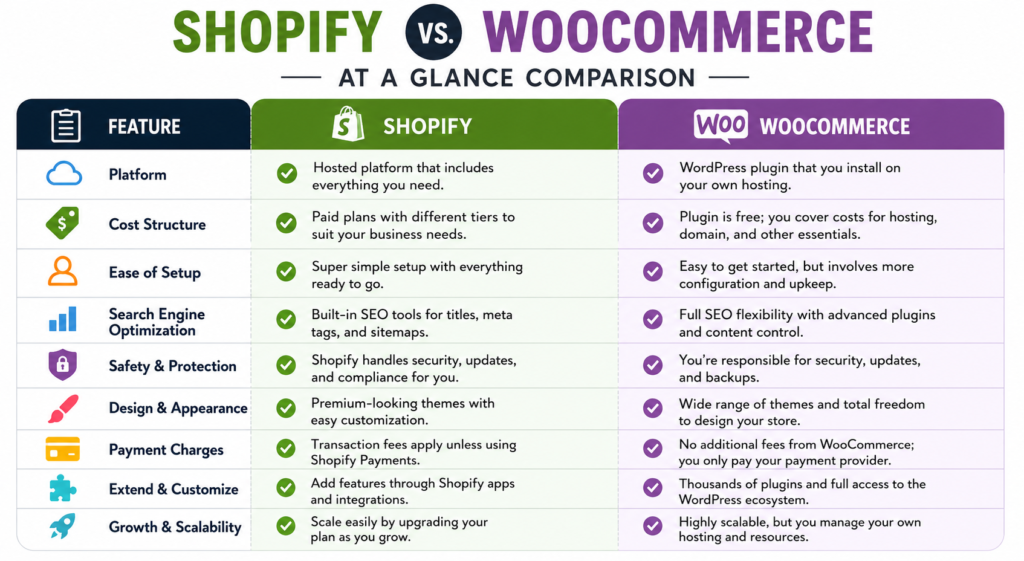
Ways to Evaluate the Best eCommerce Platform for SEO
Identifying the best ecommerce platform for SEO mainly depends on the internal technical possessions, business model, and long-term marketing strategy.
Shopify stands out as an exceptionally SEO friendly ecommerce platform for teams without dedicated web developers. It automatically secures the technical fundamentals, keeping the site secure and fast while letting merchants focus on product copywriting and external marketing campaigns.
If your growth strategy relies heavily on custom layouts, deep content hubs, and specific URL naming conventions, WooCommerce offers a higher functional ceiling. It remains the ideal option for businesses that want total ownership of their underlying code and possess the technical means to maintain a self-hosted framework.
Conclusion
Collaborating with the professional ecommerce SEO services in the USA can soothe your business strategies. Search engines utilize the metrics of the user experience. The loading plays the great role. It speeds up as direct components of their ranking algorithms. Slow performance harms conversion rates.
Frequently Asked Questions
Q1. Which platform offers better out-of-the-box search visibility?
Ans: Shopify is often more effective for beginners. It automates the speed and the configuration. Along with the security, and mobile optimization from day one WooCommerce is known to offer a long-term potential for all advanced users.
Q2: How does Shopify manage duplicate product URLs?
Ans: Shopify maps products to multiple paths based on the collections they belong to. It resolves potential duplication issues by applying canonical tags that point back to the master product link. However, large catalogs may still experience minor crawl budget inefficiencies.
Q3. Will moving from WooCommerce to Shopify hurt my search rankings?
Ans: A platform migration will not destroy your rankings if it is executed correctly. You must implement a precise 301 redirect map that connects every old WooCommerce URL to its exact new equivalent on Shopify to preserve established search equity.