

The search engine results page is facing its most significant structural realignment in twenty years. For decades, the digital economy relied on the traditional model of ten blue links. In 2026, user behavior has shifted permanently toward conversational, synthesized answers.
According to industry data, traditional search volume has declined significantly as hundreds of millions of users skip conventional search engines completely. Instead, they rely on platforms that answer questions directly.
This paradigm shift has given rise to zero click SEO, a discipline where success is no longer measured by how many clicks a website captures, but by how frequently a brand is cited within AI-synthesized responses.
To survive this transition, digital marketers must expand their playbooks from standard search engine optimization to generative engine optimization (GEO) and answer engine optimization (AEO).
How to Understand the Landscape: GEO vs. SEO
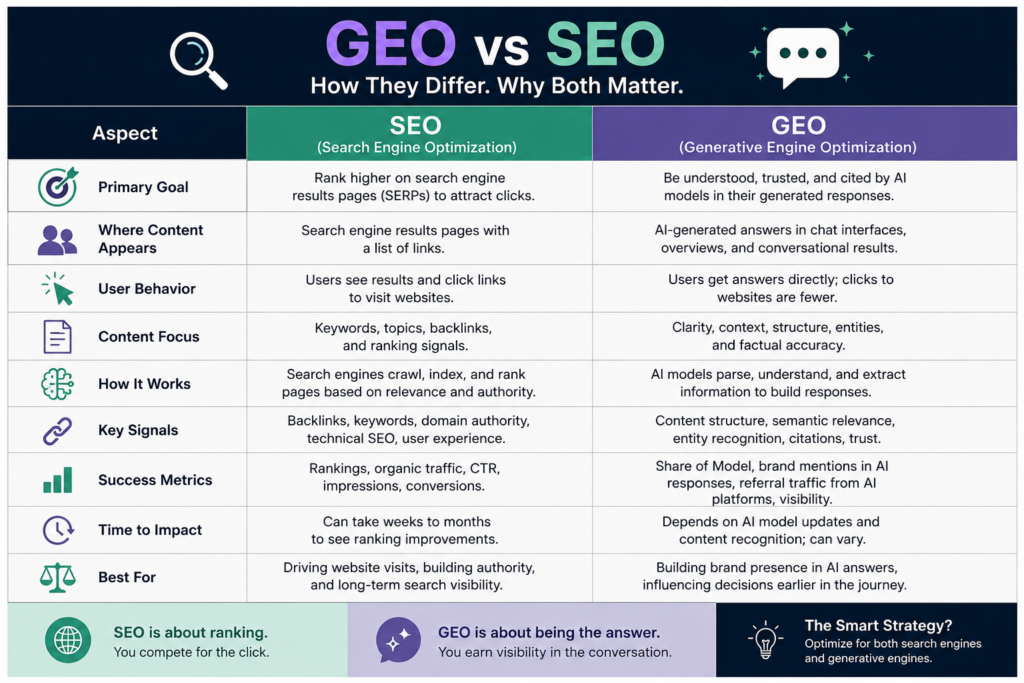
Traditional search optimization focuses on helping individual pages rank high on a results page by tracking keywords, building backlinks, and improving site speed. The primary goal is simple: secure a high ranking to win a click.
Conversely, the core objective of generative engine optimization is to ensure content is selected, summarized, and credited when an artificial intelligence platform constructs a response for a user. In this new era, the AI acts as an intermediary, pulling information via Retrieval-Augmented Generation (RAG) and serving it as a single cohesive answer.
Evaluating the structural differences between GEO vs SEO highlights how the digital ecosystem has split into two distinct methodologies.
| Operational Focus | Traditional SEO | Generative Engine Optimization (GEO) |
| Primary Target | Deterministic search index bots (Googlebot) | Probabilistic Large Language Models (GPTBot) |
| Success Metric | Click-Through Rate (CTR), Impressions, Rank | AI Citation Share of Voice, Brand Mention Velocity |
| Content Goal | Comprehensive keyword matching | High fact density and structural clarity |
| User Intent | Document retrieval | Conversational answer engine optimization |
Crack the Code with AI Search Ranking Factors in 2026
Large language models do not look at websites the way older search algorithms do. AI models evaluate content based on its mathematical probability of being accurate, neutral, and authoritative.
Protip: Princeton University research and industry studies have isolated the core AI search ranking factors that dictate whether a brand gets cited or ignored.
1. High Fact Density
AI engines prioritize content that packs verifiable, specific data into every paragraph. To satisfy the data retrieval mechanisms used by search bots, pages should include real statistics, exact percentages, and named entities rather than vague, generalized assertions.
2. The Inverted Pyramid Structure
Models prefer content written in a direct, objective style. Placing a concise, 40 to 60 word answer block directly beneath an H2 heading makes it incredibly easy for an AI to extract that passage. If an engine has to perform heavy cognitive lifting to strip away fluff, it will choose a competitor’s content instead.
3. Source Consensus and Citation Vectors
An AI builds trust by looking at what information is consistently repeated across high-authority platforms. Aligning data with established industry consensus while citing reputable external sources, such as academic journals or primary research, positions content within a high-trust vector neighborhood.
What Are the Actionable Blueprints for Modern Platforms
Optimizing for the leading platforms requires a multi-pronged approach because different search products deploy unique architectures to synthesize their answers. To thrive in a zero-click ecosystem, brands must move past generic content creation and implement platform-specific technical blueprints.
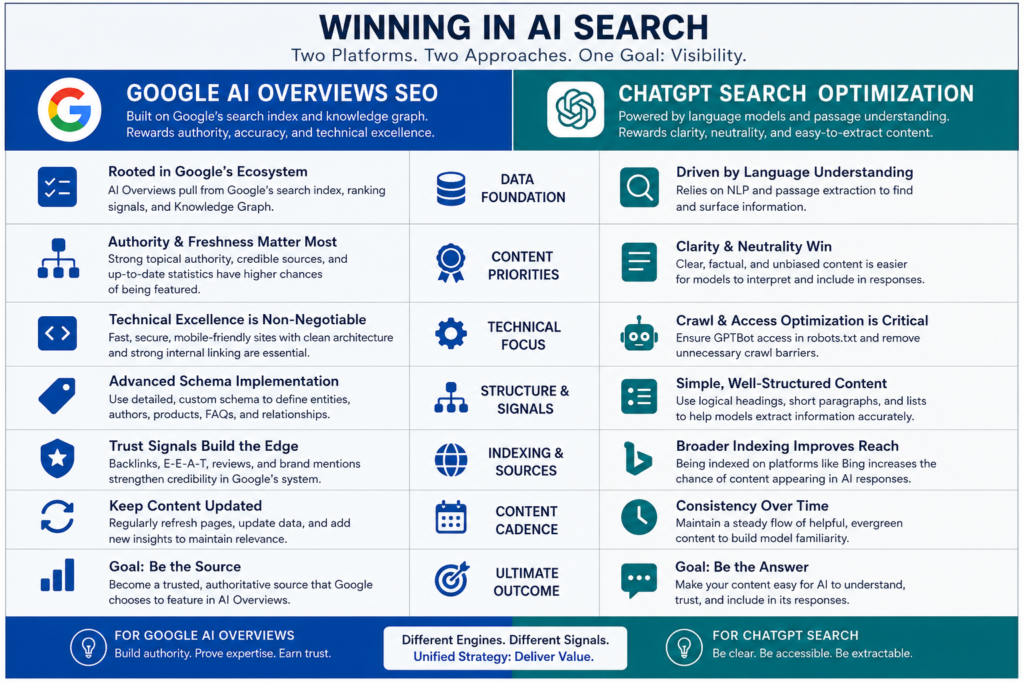
Google AI Overviews and ChatGPT Search rely on fundamentally different retrieval mechanisms, meaning a one-size-fits-all approach no longer works.
Optimizing for Google requires a heavy emphasis on structural entity mapping, deep Schema.org integration, and maintaining absolute topical authority within its legacy search index.
Conversely, winning visibility in ChatGPT Search demands a highly objective, encyclopedia-style prose that completely strips away promotional marketing fluff, alongside flawless technical access for OpenAI’s crawler.
By deliberately engineering web pages to feed these distinct algorithmic architectures, businesses ensure their data is easily extracted, trusted, and cited as the definitive answer.] ➔ [High Fact Density
Winning in Google AI Overviews SEO
Google’s AI features are deeply connected to its existing search index and knowledge graph. Securing visibility in an AI Overviews SEO framework requires a flawless technical foundation.
Websites must deploy extensive, customized schema markup to help the algorithm map relationships between entities, authors, and products. Furthermore, domain authority remains a major factor. Google heavily favors established topical authority and fresh, regularly updated statistical data over generalist websites.
Mastering ChatGPT Search Optimization
OpenAI’s search architecture relies intensely on natural language processing and passage extraction. Executing successful ChatGPT search optimization requires a completely neutral, authoritative tone of voice.
The content must avoid overly promotional language. Furthermore, technical teams must ensure that access for GPTBot is fully optimized within the robots text file and that the website is thoroughly indexed within secondary indexes like Bing, which frequently feed conversational models.
How to Scale Performance with Expert AI SEO Services
Adapting an enterprise web presence to handle the complexities of conversational search requires specialized tooling and deep technical insights.
- Many businesses in the United States are shifting away from legacy marketing agencies to partner with cutting-edge AI SEO services.
- Investing in advanced AI SEO strategies allows brands to monitor metrics that traditional platforms cannot track, such as tracking a brand’s share of voice inside LLM responses. Partnering with dedicated SEO experts in US agencies ensures that data frameworks, semantic structures, and brand mentions are optimized globally across all generative engines.
Conclusion
The evolution of search into a zero click SEO ecosystem does not mean content marketing is dying. It simply means the value exchange has changed. While organic click-through rates for basic informational queries have declined, the visibility gained from being a cited source inside an AI response builds massive brand authority. By focusing on structural clarity, fact density, and semantic depth, brands can secure their footprint inside the answers that shape the future.
Frequently Asked Questions (FAQs)
Q1. What is the main difference between traditional search optimization and generative engine optimization?
Ans: Traditional optimization builds content to rank on a page of external links to attract a direct click. Generative optimization structures content so an artificial intelligence model can easily parse, trust, and extract the information to build its own synthesized response.
Q2. Does using exact keywords still matter for AI search visibility?
Ans: Exact-match keyword stuffing is completely ineffective. Modern models utilize natural language processing to look at semantic relevance, context, and the relationships between different conceptual entities rather than counting how many times a specific phrase is repeated.
Q3.How can a business measure its visibility if users are not clicking through to the website?
Ans: Marketers must track alternative metrics like Share of Model, brand mention velocity across top language models, and direct referral traffic coming out of conversational interfaces to measure overall market reach.